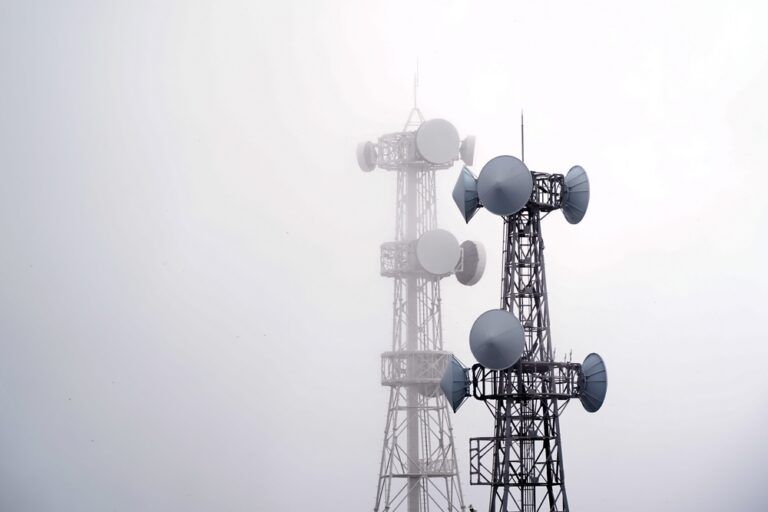
One-to-one delivery is the simplest and most familiar way to distribute data across a network. For individual transactions or small-scale distribution, it works well. But when organizations need to deliver the same data (such as high-value live content, advertising, software updates, alerts, global positioning system (GPS) corrections, or timing information) to thousands or even millions of endpoints at once, repeatedly transmitting identical data becomes highly inefficient.
In a traditional model, sending a software update to one million devices requires transmitting the same data one million times. Each duplicate transmission consumes shared last-mile bandwidth, strains spectrum, and drives up transport costs. Redundant traffic floods constrained networks, creating congestion exactly where capacity is limited.
By contrast, EdgeBeam Wireless, the world’s first hybrid network operator, transmits the data once. A single broadcast replaces millions of duplicate transmissions, reducing sender costs, preserving valuable spectrum, and ensuring timely, consistent delivery to every endpoint. The result is not only greater efficiency, but also more stable network performance. No unnecessary retries. No bandwidth spikes. Just predictable, high-quality distribution at scale. This article explains how hybrid networking, powered by EdgeBeam, makes it possible.
What is a Hybrid Network Operator (HNO)?
A hybrid network operator (HNO) is an organization that uses multiple ATSC 3.0 broadcast and broadband networks to expand capacity and simultaneously distribute data-dense edge traffic, such as video, software, mapping, or artificial intelligence (AI) model updates.
Rather than relying on a single network type (such as cellular or satellite alone), a hybrid network operator combines ATSC 3.0 for high-volume outbound content distribution with cellular, satellite, or broadband network assets for a hybrid delivery, using each network type for its strengths.
This is not a loose collection of independent networks working side by side. Instead, the networks are tightly integrated and coordinated to function as a unified system.
The ATSC 3.0 broadcast network delivers data using a multicast, one-to-many model. The same data is transmitted once and received at the same time by the many edge endpoints. The other network types carry back packet repair and telemetry data, which allows the diverse networks to be viewed and treated as one hybrid network because they work together to accomplish the delivery goals.
When a group of devices requires the same data (such as software updates, alerts, maps, content, or timing information), a hybrid network leveraging ATSC 3.0 broadcast provides a clear performance advantage because:
- Data is transmitted once, not thousands or millions of times.
- Network load and cost do not increase as the audience grows.
- The delivery result is not affected by varying one-to-one network traffic levels.
Hybrid Network Architecture Explained
A hybrid network architecture combines at least two distinct network infrastructures to form a single, cohesive, cost-effective, secure, and flexible system. Common hybrid network architectures include:
Hybrid Network Topology
A hybrid network topology combines two or more basic network designs (like star, ring, bus, mesh) to leverage the strengths of each, creating structures for specific business needs. Hybrid topologies are often seen in larger enterprises with complex requirements for performance and fault tolerance.
Hybrid Cloud Network
A hybrid cloud network is infrastructure that connects public clouds, private clouds, and on-premises data centers. It enables data and applications to move between these environments, keeping sensitive data on-premises while using the public cloud for scalability.
Hybrid Access Network
A hybrid access network combines two or more different communication technologies, typically a fixed-line broadband connection (like fiber) and a wireless network (like 4G/5G or satellite), to provide faster, more reliable, and higher-bandwidth internet access.
Hybrid SDN
A hybrid software-defined network (hybrid SDN) combines traditional, decentralized networking protocols, like open shortest path first (OSPF) or border gateway protocol (BGP), with centralized SDN control in the same environment. This approach allows for a gradual transition to new technology by allowing SDN-enabled devices to co-exist with legacy infrastructure.
Hybrid SD-WAN
A hybrid software-defined wide-area network (hybrid SD-WAN) combines traditional, secure multiprotocol label switching (MPLS) circuits with lower-cost public internet broadband or 4G/5G connections to connect, manage, and optimize network traffic. It leverages software intelligence to intelligently route traffic based on application priority, improving flexibility and reducing costs while maintaining performance for critical applications.
Hybrid WAN
A hybrid wide-area network (WAN) combines multiple connection types, typically private MPLS circuits and public internet (broadband, 4G/5G, fiber), into a single, managed network to optimize cost, performance, and reliability. It allows businesses to send critical traffic over secure, high-quality links while routing routine traffic over cheaper public internet, often utilizing SD-WAN technology to manage traffic dynamically.
Hybrid Wireless Network
A hybrid wireless network combines two or more different communication technologies (such as WI-Fi, 4G/5G, or satellite) into a single, integrated, and flexible network infrastructure. This approach blends the stability of wired connections with the mobility of wireless, enhancing bandwidth, improving reliability, and providing, for example, backup options via alternative technologies.
How Hybrid Networking Works Using ATSC 3.0
Let’s use the example of automotive software and firmware updates to explain how hybrid networking works using ATSC 3.0.
Imagine that a logistics company operates a nationwide fleet of delivery vehicles equipped with onboard computers, navigation systems, and sensors. Periodically, the company needs to push large software and firmware updates, often hundreds of megabytes, to tens of thousands of vehicles.
Using cellular networks alone creates several problems:
- Updates must be sent individually to each device or vehicle
- Network congestion increases during rollout windows
- Costs scale linearly with the number of vehicles
- Vehicles in rural or congested areas experience delays or delivery failures
To solve this, the company adopts a hybrid networking model that combines ATSC 3.0 broadcast with broadband.
Step 1: Data Preparation
The update package is prepared once and secured using encryption and signing. Metadata for identification gets added.
Step 2: One-to-Many Distribution via Broadcast
The update is delivered once over an ATSC 3.0 broadcast signal from the enterprise cloud to the fleets (i.e., downlink) within an operating region.
- Every vehicle equipped with an ATSC 3.0 receiver receives the update simultaneously
- No additional network load is created as more vehicles receive the data
- Delivery is deterministic and unaffected by cellular network congestion
Step 3: Control, Coordination and Fallback via Broadband
Broadband connectivity for control traffic from the fleets to the enterprise application in the cloud (i.e., uplink) is used for:
- Device authentication and authorization
- Installation scheduling (e.g., install only when parked)
- Status reporting and acknowledgments of data delivery
- Targeted follow-up messages or exceptions
- Edge gateway reception and local redistribution of broadcast data
- Fallback delivery of the update if a vehicle misses the broadcast due to downtime
This scenario succeeds because each network is used where it has a performative advantage. Broadcast excels at large-scale, simultaneous data delivery. Broadband excels at control, interaction, and exception handling. Hybrid networking combines both into a single, efficient pipeline so that:
- The update is transmitted once, not tens of thousands of times
- Cellular bandwidth usage and related costs drop dramatically
- Rollouts deploy faster and more predictably
- Vehicles in remote or congested areas receive updates reliably
- Operational visibility is preserved through broadband feedback
Hybrid Networking Solutions for Data-Dense Edge Traffic
By combining broadcast’s one-to-many performative advantage with the flexibility and control of broadband networks, organizations can scale delivery, reduce congestion, and improve reliability for data-dense applications.
As the world’s first hybrid network operator, EdgeBeam applies this model using ATSC 3.0 to help enterprises, public agencies, and solution providers distribute data efficiently, economically, and simultaneously without the limitations of traditional one-to-one delivery.
If your organization is exploring new ways to move data at scale, reduce last-mile strain, or support emerging edge use cases, EdgeBeam can help.